After writing my list of the top 10 books of 2015 I got to thinking about what the ratio of independant/self published authors was to traditionally published ones and how the quality compared.
The reasoning behing wanting to check the quality is simple: traditional books still sell and (as far as I can see) far outsell independant authors. Now a lot of this is going to be marketing but a lot of the books I read I've never seen any marketing for the author and have simply come across them. Add in the fact that traditionally published books are usually significantly more expensive (even as eBooks) than independantly published ones, perhaps the extra cost can be accounted for by the extra quality of having professional editors pick the stories that get published. I am sure that many people are put off independant books because they think they will be inferior (I admit this is anecdotal).
Down the to analysis. This is all going to be subjective but hopefully usefull nonetheless.
I read 33 books for the first time in 2015. 19 of these were independant (usual eBooks) and 14 were traditionally published (all printed books except for one short story). The skew there is simply because as eReaders are more portable I get more opportunity to read eBooks than printed ones, so therefore I read more of them.
As I review everything I read on Goodreads it pretty easy to have a look at the star ratings I gave and split the list into independent and traditionally published authors. The results are quite interesting simply because it seems that from my point of view in 2015 they both scored about the same. Independant authors scored an average of 4.42 stars per book, traditional publishers 4.36. They have very similar ratings for each of the star ratings to, 58% to 57% for 5 star, 26% to 29% for 4 star and 16% to 14% for 3 stars and below. Traditional publishing scored the only 2 star of the year for The Long Utopia by Stephen Baxter and Terry Pratchett which I thought was rather weak (review here),
Looking further into this, though, the results should be markedly biased towards traditional publishing if variable quality is assumed for authors that one has never read before.
A lot of the eBooks I read are essentially random choices, they have either been offered to me for review (in which case they may be something I wouldn't have normally picked up) or are picked rather haphazardly from sites like Smashwords where large numbers of books are published daily by their authors. The printed ones have by and large been from authors I knew I liked before I picked the book up. So in general I would have expected independent books to score lower simply because there is more chance I won't enjoy them.
Even more detail on that - and naming names. In terms I independent authors, the new ones I read books for in 2015 were: Greg Johnson, Kurt Chambers, Travis Luedke, John Darryl Winston, David Chilcott, John Dolan, James Minter, Diana Febry, Deborah Coonts and Charles Kaluza. Of these I read multiple books by Kurt Chambers, John Darryl Winston and David Chilcott. I read the books of only one independant author that I was already familiar with - Katrina Cope, and then she had started a new series with a different feel to it.
For traditional publishers I had read 7 of the authors before (Chris Brookmyre, Stephen Hunt, Alastair Reynolds, Matthew Reilly, Stephen Baxter & Terry Pratchett and Joe Abercrombie). Of these only Alastair Reynolds and Matthew Reilly's books were not part of a previous series of theirs. The new authors I found in 2015 were Boyd Morrison, David Gibbins, Luke Scull and Alex Connor and of these only Boyd Morrison scored 5 stars for one of the 4 books of his I read.
The result is that for independant books I was pleased when I found an author I really liked (most of them) and those that didn't quite make 4 or 5 stars were will worth reading. For the traditionally published works it is perhaps a little disappointing that authors I do like have not been more consistently delivering 5 stars.
The inevitiable conclusion here is twofold. Firstly, independant authors are on the ascendent and secondly don't be afraid to dabble in independant works for fear that they may be self indulgent or just plan bad. It is daunting that there are a lot of books to choose from but that shouldn't put anyone off. I say take the plunge and grab an eBook by an independant author today. You won't regret it.
Wednesday, 27 January 2016

Friday, 8 January 2016
Books of 2015
2015 was a year that saw nearly 40 books read, and looking back I was surprised how many had been 4 and 5 star. There is an outstanding quality of work out that and I have to say from what I have seen the independant authors have the edge on the major publishers at the moment.
 Most famous for his Revelation Space novels, Reynolds released this short story (more of a novella) in the summer. The plot is unrelated to any of his previous work, as far as can be determined anyway. As with a lot of his work the characters are neither good nor bad but simply human, capable of both enormous compassion and horrific cruelty.
Scur is captured by the enemy at the end of a war that has gone on for years and spanned many worlds. After being rescued she finds herself in a transport ship with hundreds of other soldiers from both sides, some of which are wanted for war crimes. But something has gone wrong and the ship has not arrived at its intended destination. With factions of the passengers pushing for all out war with each other, Scur tries to mediate the conflict and resolve their apparently hopeless situation. But which side is she on and who is prepared to stand with her - or against her?
The failing environment of the ship is well drawn by Reynolds, as are the various members of the factions on board. As would be expected there are some quite unpleasant occurrences, either deliberate acts or accidents. A well written and timely reminder that epic science fiction can be personal.
My Goodreads review: https://www.goodreads.com/review/show/1230678821
 This time last year I hadn't heard of Boyd Morrison. Now he is firmly established as one of my favourite commercially published authors and definitely the number one thriller writer for me. The Ark is the first in a series of books he has written featuring engineer Tyler Locke as the main character.
There are two main reasons his work reads so well in my opinion; firstly he will take a fairly fantastic myth (in this case the story of Noah's Ark) and provides a logical thesis to show that the story we have now may have a basis in real events. In this case, Noah's Ark wasn't a ship but a refuge in a cave, and the flood was a deadly virus. When an end of the world cult discover a sample of this virus and engineer it to wipe out humanity, it is up to Locke to stop them.
The second factor is the hero, Tyler Locke himself. An engineer with a scientific outlook he doesn't take the incredible concepts he is presented with at face value. Instead he works through them methodically to work out what is really going on and this works well. He takes nothing on faith and questions everything and for me that resonates. He exchanges banter with his friend in the impressive shape of Grant Westwood, former wrestler, Army Ranger and electronics and explosives specialist. Unlike other pairings in adventure/thriller novels both are capable and Grant never feels like a side kick, there for muscle or comic relief.
The plots in the books twist as unbelievable myth is turned into possible science, and with Morrison's interest in fast vehicles and bleeding edge technology there are numerous chase scenes and gadgets galore. At the end of the books Morrison always has a little explanatory chapter where some of the more exotic technology is revealed to be real - or at least on the cusp of being real.
If you want a thrill ride, forget the rest, read Morrison. He is the latest collaborator with Clive Cussler in the book Piranha and that may prove to be something special and lift it above the rest of the recent Cussler output.
My Goodreads review: https://www.goodreads.com/review/show/1357125785
 Tails and Fixers manages to combine exploration of another planet, battle for survival, social commentary and romance all in one story, with enough left over for some philosophical musings on the origin of life in the universe.
It's a lot to pack in but Charles Kaluza writes fluently managing to move seamlessly between phases of the plot. The hero is Floyd, sent on a one-way mission to another world which has broadcast a radio message. This turns out to have been a distress call and Floyd arrives to an almost destroyed world and initially must use all his ingenuity to survive.
When he eventually contacts survivors he finds two symbiotic races living in a enclosed environment and very wary of him and what he represents. He finds their social order to be somewhat at odds with his ideals and is determined to leave and make some sort of life for himself on the surface, but with allies and enemies in the alien hierarchy, will he be allowed to do this?
There is so much to like about this book, plenty of good ideas and interesting characters. There are plenty of twists and reveals as the plot winds towards it's conclusion.
My Goodreads review: https://www.goodreads.com/review/show/1428836433
 The glitz and glamour of Las Vegas hides an ugly underbelly of seediness, sex and the ruthless pursuit of money. Lucky O'Toole knows all about every angle. As the customer services manager for a top casino resort hotel it his her job to ensure that any little problems are ironed out. Naked drunken man in the stairwell? Call Lucky. Escaped snake in a hotel room? Call Lucky. Cocktail waitress falls out of the casino's helicopter to her death? Call Lucky.
The last proves to be something that even Lucky can't simply smooth over. The more she tries to find out the more she is sure that the death is no accident.and that lot of people are hiding a lot of information from her. But with the annual adult movie awards about to hit town in the same week as a swingers convention, Lucky might not have much time to find answers.
This novel is fun and sassy, perfectly balancing the darker aspects - the murder and the dark side of Vegas - with a freewheeling narration by the hugely likeable main character. She is someone who is always sorting problems out for others but can't seem to grasp the problems in her own life.
The main plot is obviouly the how and why of the fateful helicopter plunge but there are plenty of side plots along with real genuine laughs. In short this is a total delight of a book and I'll definitely be reading more of the series.
My Goodreads review: https://www.goodreads.com/review/show/1409699507
 Although not technically one of the best books of the year (I only rated it 4 stars) this was definitely a highlight of the reading year.
The plot of this book starts out simply enough with Dan convinced that foul play was involved in the death of his daughter, who apparently committed suicide. With the police - and nearly everyone else - thinking his is being delusional he decides to find out the truth himself.
The journey spans the country and each twist moved Dan deeper into a dark world and to making desperate decisions, sometimes with catastrophic results.
If the plot sounds like something that can be found serialised on the television that is exactly how it feels to read but with the benefit of not having to wait for a week to read the next chapter. The characters are drawn very well and it's really unclear how everything fits together until very near the end. Exceptionally well plotted and well written.
My Goodreads review: https://www.goodreads.com/review/show/1372314683
 Science fiction covers a wide range of story types, from the big bangs per buck of space opera to the very small scale and subtle tales that seem like normal life - just a little skewed in some way.
IA: Initiate is definitely at the small scale end. It is the equivalent of the close-up magician making coins disappear right in front of you rather than making whole buildings vanish. Both are just as impressive and IA: Initiate never fails to impress.
The story follows Naz, a teenage boy who lives with his younger sister in a ghetto called the Exclave. Their parents split up years before and now both are dead - the father in a car accident that Naz was involved in and the mother killed by her abusive new partner. Naz himself has no memory of anything before the car crash which killed his father.
Naz just wants a quiet life and to look after his sister. He tries just hard enough at school to get by without attracting attention. He does odd jobs for local shopkeepers. He doesn't want to change the world. But he is not quite a normal child. He has powerful and realistic dreams and hears voices when he becomes stressed.
The reader follows Naz as he tries to live his life and deny that he is special, but fate has other ideas.
Although aimed at a 'young adult' audience I would recomment this to anyone.
My Goodreads review: https://www.goodreads.com/review/show/1291122933
 Easily the shortest book I read this year it's hard to even claim this even long enough to qualify as a short story. In a large part that brevity its it's charm, giving it a lot of punch per page.
Set out as a series of emails (and other documents) it describes what can best be described as a 'difference of opinion' between Jim Fosse and one of the finance team at his company. Fosse is trying to claim a very large sum for expenses for a recent business trip and gets upset when it is questioned.
Although the actual tone of the correspondence is serious the way it is laid out is hilarious; Fosse becomes abusive very quickly while the finance employee tries to remain professional. Anyone who has worked in an office will have heard of sales reps presenting slightly questionable expense claims but Fosse takes it to a new level. On being challenged for the lack of recipts, for example, he responds that 'hooker's don't tend to give receipts'
Very irreverent, highly split-your-sides amusing even as the tone turns darker and the humour blacker it still remains fascinating.
Perhaps the sense of humour or the subject matter won't appear to everyone, and adult themes mean it's not for the faint hearted but I just thought it was terrific.
My Goodreads review: https://www.goodreads.com/review/show/1312743413
The book follows an initially unnamed woman who has been murdered three times in previous lives and as such has been allowed to become an angel to stop innocents being harmed by evil.
Unlike most stories (at least those I have read) involving angels this isn't overtly religious and indeed the angels are pretty much kick-ass martial arts experts who take the phrase 'battling evil' quite literally. I described them as being like super heroes in my review and that is what it is like - it is a bit like an angelic version of X-Men.
The heroine is likeable and always wants to do what she feels is right even when it could get her into trouble. There is a streak of trouble romance for her running through the book so this is probably more suited to female rather than male readers, but the actual demon fighting is great fun for anyone.
A terrific start to a new series which is already showing a lot of promise to deliver.
My Goodreads review: https://www.goodreads.com/review/show/1283240148
 Charlotte is an ordinary teenage girl on holiday with her family when she finds her way to a strange shop in an alley and is given a strange glowing globe which leads her to another world - one inhabited by elves and other strange creatures.
She discovers that the world is under threat from the evil Siren and that there is a prophesy of a person from another world who will save them - someone only known as the Truth Teller.
Despite her initial bewilderment Charlotte must travel to find the way back home, facing many dangers. Is she perhaps the Truth Teller?
The aim of this book is to get teenage girls to read epic fantasy and it does an excellent job, not putting a foot wrong. To those of us who were brought up on Lewis, Tolkien and epic fantasy in general the plot might seem a bit formulaic and cliched but Chambers attacks the story with relish giving a slightly different take on the familiar plot lines. After all, this is aimed at those who have never read fantasy before so does not need to provide some new twist, and to an extent it's a relief to read something that is comfortable just being a straightforward and fun read.
Despite being aimed at the female young adult audience this is still a good read for anyone who wants a light bite of epic fantasy without having to wade through appendices of family trees or volumes as thick as a brick. A delight to read.
My Goodreads review: https://www.goodreads.com/review/show/1237595228
 I read the third novel of Stephen Hunt's highly imaginative Jackelian novels, The Rise of the Iron Moon, last year and was amazed by the density and complexity of the world it presented so made sure that I started the series from the beginning with The Court of the Air.
The first thing to say is that Hunt makes you work reading this book, but it pays off. He has essentially reinvented a Victorian style society and placed it into a very strange world with its own cultures, peoples and mythology. There are very few points of reference for the reader and nothing is explained so it's almost a note-taking exercise working out what is going on.
Not one for the casual reader then. But definitely one for anyone who wants to close the back cover having felt that they have accomplished something. The plot concerns machinations by foreign powers to take the land of Jackals by force and the rather disparate band who discover the plot and must thwart it. Hunt is not shy of the deus ex machina ending which means that things can build right towards the final pages.
The depth and scale of the concepts won't appeal to all but there is something in it that just snags my imagination. Possibly an acquired taste but one I'm very happy to have.
My Goodreads review: https://www.goodreads.com/review/show/1067045739
My Books of 2015
I would say this is in no particular order, but it is in order of the Author's first name, which is as arbitrary as anything else. Of all the books I read these 10 are the ones I thought were particularly good or stayed with me after I had turned the last page.Alastair Reynolds - Slow Bullets

Scur is captured by the enemy at the end of a war that has gone on for years and spanned many worlds. After being rescued she finds herself in a transport ship with hundreds of other soldiers from both sides, some of which are wanted for war crimes. But something has gone wrong and the ship has not arrived at its intended destination. With factions of the passengers pushing for all out war with each other, Scur tries to mediate the conflict and resolve their apparently hopeless situation. But which side is she on and who is prepared to stand with her - or against her?
The failing environment of the ship is well drawn by Reynolds, as are the various members of the factions on board. As would be expected there are some quite unpleasant occurrences, either deliberate acts or accidents. A well written and timely reminder that epic science fiction can be personal.
My Goodreads review: https://www.goodreads.com/review/show/1230678821
Boyd Morrison - The Ark

There are two main reasons his work reads so well in my opinion; firstly he will take a fairly fantastic myth (in this case the story of Noah's Ark) and provides a logical thesis to show that the story we have now may have a basis in real events. In this case, Noah's Ark wasn't a ship but a refuge in a cave, and the flood was a deadly virus. When an end of the world cult discover a sample of this virus and engineer it to wipe out humanity, it is up to Locke to stop them.
The second factor is the hero, Tyler Locke himself. An engineer with a scientific outlook he doesn't take the incredible concepts he is presented with at face value. Instead he works through them methodically to work out what is really going on and this works well. He takes nothing on faith and questions everything and for me that resonates. He exchanges banter with his friend in the impressive shape of Grant Westwood, former wrestler, Army Ranger and electronics and explosives specialist. Unlike other pairings in adventure/thriller novels both are capable and Grant never feels like a side kick, there for muscle or comic relief.
The plots in the books twist as unbelievable myth is turned into possible science, and with Morrison's interest in fast vehicles and bleeding edge technology there are numerous chase scenes and gadgets galore. At the end of the books Morrison always has a little explanatory chapter where some of the more exotic technology is revealed to be real - or at least on the cusp of being real.
If you want a thrill ride, forget the rest, read Morrison. He is the latest collaborator with Clive Cussler in the book Piranha and that may prove to be something special and lift it above the rest of the recent Cussler output.
My Goodreads review: https://www.goodreads.com/review/show/1357125785
Charles Kaluza - Tails and Fixers
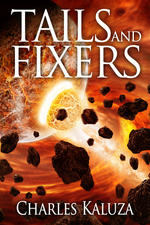
It's a lot to pack in but Charles Kaluza writes fluently managing to move seamlessly between phases of the plot. The hero is Floyd, sent on a one-way mission to another world which has broadcast a radio message. This turns out to have been a distress call and Floyd arrives to an almost destroyed world and initially must use all his ingenuity to survive.
When he eventually contacts survivors he finds two symbiotic races living in a enclosed environment and very wary of him and what he represents. He finds their social order to be somewhat at odds with his ideals and is determined to leave and make some sort of life for himself on the surface, but with allies and enemies in the alien hierarchy, will he be allowed to do this?
There is so much to like about this book, plenty of good ideas and interesting characters. There are plenty of twists and reveals as the plot winds towards it's conclusion.
My Goodreads review: https://www.goodreads.com/review/show/1428836433
Deborah Coonts - Wanna Get Lucky?

The last proves to be something that even Lucky can't simply smooth over. The more she tries to find out the more she is sure that the death is no accident.and that lot of people are hiding a lot of information from her. But with the annual adult movie awards about to hit town in the same week as a swingers convention, Lucky might not have much time to find answers.
This novel is fun and sassy, perfectly balancing the darker aspects - the murder and the dark side of Vegas - with a freewheeling narration by the hugely likeable main character. She is someone who is always sorting problems out for others but can't seem to grasp the problems in her own life.
The main plot is obviouly the how and why of the fateful helicopter plunge but there are plenty of side plots along with real genuine laughs. In short this is a total delight of a book and I'll definitely be reading more of the series.
My Goodreads review: https://www.goodreads.com/review/show/1409699507
Diana J Febry - Each To Their Own

The plot of this book starts out simply enough with Dan convinced that foul play was involved in the death of his daughter, who apparently committed suicide. With the police - and nearly everyone else - thinking his is being delusional he decides to find out the truth himself.
The journey spans the country and each twist moved Dan deeper into a dark world and to making desperate decisions, sometimes with catastrophic results.
If the plot sounds like something that can be found serialised on the television that is exactly how it feels to read but with the benefit of not having to wait for a week to read the next chapter. The characters are drawn very well and it's really unclear how everything fits together until very near the end. Exceptionally well plotted and well written.
My Goodreads review: https://www.goodreads.com/review/show/1372314683
John D Winston - IA: Initiate

IA: Initiate is definitely at the small scale end. It is the equivalent of the close-up magician making coins disappear right in front of you rather than making whole buildings vanish. Both are just as impressive and IA: Initiate never fails to impress.
The story follows Naz, a teenage boy who lives with his younger sister in a ghetto called the Exclave. Their parents split up years before and now both are dead - the father in a car accident that Naz was involved in and the mother killed by her abusive new partner. Naz himself has no memory of anything before the car crash which killed his father.
Naz just wants a quiet life and to look after his sister. He tries just hard enough at school to get by without attracting attention. He does odd jobs for local shopkeepers. He doesn't want to change the world. But he is not quite a normal child. He has powerful and realistic dreams and hears voices when he becomes stressed.
The reader follows Naz as he tries to live his life and deny that he is special, but fate has other ideas.
Although aimed at a 'young adult' audience I would recomment this to anyone.
My Goodreads review: https://www.goodreads.com/review/show/1291122933
John Dolan - Jim Fosse's Expense Claim

Set out as a series of emails (and other documents) it describes what can best be described as a 'difference of opinion' between Jim Fosse and one of the finance team at his company. Fosse is trying to claim a very large sum for expenses for a recent business trip and gets upset when it is questioned.
Although the actual tone of the correspondence is serious the way it is laid out is hilarious; Fosse becomes abusive very quickly while the finance employee tries to remain professional. Anyone who has worked in an office will have heard of sales reps presenting slightly questionable expense claims but Fosse takes it to a new level. On being challenged for the lack of recipts, for example, he responds that 'hooker's don't tend to give receipts'
Very irreverent, highly split-your-sides amusing even as the tone turns darker and the humour blacker it still remains fascinating.
Perhaps the sense of humour or the subject matter won't appear to everyone, and adult themes mean it's not for the faint hearted but I just thought it was terrific.
My Goodreads review: https://www.goodreads.com/review/show/1312743413
Katrina Cope - Fledgling
Katrina Cope was one of my favourite authors last year with her Sanctum series and Jayden and the Mysterious Mountain made my books of 2014 list. This year Cope started a new series, firmly positioned for young adults.
The book follows an initially unnamed woman who has been murdered three times in previous lives and as such has been allowed to become an angel to stop innocents being harmed by evil.
Unlike most stories (at least those I have read) involving angels this isn't overtly religious and indeed the angels are pretty much kick-ass martial arts experts who take the phrase 'battling evil' quite literally. I described them as being like super heroes in my review and that is what it is like - it is a bit like an angelic version of X-Men.
The heroine is likeable and always wants to do what she feels is right even when it could get her into trouble. There is a streak of trouble romance for her running through the book so this is probably more suited to female rather than male readers, but the actual demon fighting is great fun for anyone.
A terrific start to a new series which is already showing a lot of promise to deliver.
My Goodreads review: https://www.goodreads.com/review/show/1283240148
Kurt Chambers - Truth Teller

She discovers that the world is under threat from the evil Siren and that there is a prophesy of a person from another world who will save them - someone only known as the Truth Teller.
Despite her initial bewilderment Charlotte must travel to find the way back home, facing many dangers. Is she perhaps the Truth Teller?
The aim of this book is to get teenage girls to read epic fantasy and it does an excellent job, not putting a foot wrong. To those of us who were brought up on Lewis, Tolkien and epic fantasy in general the plot might seem a bit formulaic and cliched but Chambers attacks the story with relish giving a slightly different take on the familiar plot lines. After all, this is aimed at those who have never read fantasy before so does not need to provide some new twist, and to an extent it's a relief to read something that is comfortable just being a straightforward and fun read.
Despite being aimed at the female young adult audience this is still a good read for anyone who wants a light bite of epic fantasy without having to wade through appendices of family trees or volumes as thick as a brick. A delight to read.
My Goodreads review: https://www.goodreads.com/review/show/1237595228
Stephen Hunt - The Court of the Air

The first thing to say is that Hunt makes you work reading this book, but it pays off. He has essentially reinvented a Victorian style society and placed it into a very strange world with its own cultures, peoples and mythology. There are very few points of reference for the reader and nothing is explained so it's almost a note-taking exercise working out what is going on.
Not one for the casual reader then. But definitely one for anyone who wants to close the back cover having felt that they have accomplished something. The plot concerns machinations by foreign powers to take the land of Jackals by force and the rather disparate band who discover the plot and must thwart it. Hunt is not shy of the deus ex machina ending which means that things can build right towards the final pages.
The depth and scale of the concepts won't appeal to all but there is something in it that just snags my imagination. Possibly an acquired taste but one I'm very happy to have.
My Goodreads review: https://www.goodreads.com/review/show/1067045739
Friday, 9 October 2015
Long Lost Authors
I was musing the other day about authors I used to like who just sort of went missing. In the days before Twitter and other social media (anybody remember that?) or indeed the easy access of the Internet in general the only access to authors was when books were published. Sometimes the authors just stopped publishing books and there was never any idea why. Even today trying to find information is hard because despite it's huge volume of content for certain things the Internet only really started recording information in the last 20 years or so.
So here are three authors that I used to enjoy but who just disappeared, sometimes abruptly. I'm guessing that they were dropped by their publishing company after poor sales but I still remember their works fondly.
Adrian Cole
A terrific fantasy author he was doing grimdark years before anyone else. His two major cycles - <i>The Omaran Saga</i> and <i>The Innasmourn Saga</i> - were vaguely linked as being in the same multiverse but with very different subject matter. <i>The Omaran Saga</i> was notable to me at the time (this was in the late 80s) for being a fantasy series that owed essentially nothing to Tolkien. Telling the tale of the planet of Omara under threat of being destroyed by the actions of the forgotten Sorceror Kings. It also featured one of the best anti-heroes (and bad guy made good) in fiction in the shape of Simon Wargallow, a Deliverer, a race of humans devoted to destroying any evidence of magic who had their right hands surgically replaced by a 'killing steel'.
<i>The Innasmourn Saga<i> was even more epic. Mankind is on the run from the vicious and war-obsessed Csendook who are moving from world to world and destroying and capturing humans in their millions. In one last desperate attempt to escape they create a rift to another cycle of worlds and arrive on Innasmourn. But the very planet is aware and their presents is a disruption to the natural balance. A small group of natives and a human must somehow prevent the Csendook from arriving on Innasmourn and reconcile humans to the planet. I once counted the rival factions and objectives in this series of books and it came to thirteen, a quite astonishing number to manage but Cole does it. And there is some superb storytelling roving from Innasmorn back to the wartorn worlds where the Csendook rule.
And then there was... nothing. I did see something about Cole writing children's books but I have never seen another one of his books and have sadly lost the copies I did have in the intervening years.
Andrew Harman
Following the success of Terry Pratchett in making fantasy funny, there were any number of attempts to duplicate this by the publishers of the day. I read a few and the only one that generally impressed was Harman. He created a fairly standard fantasy setting of warring kingdoms and then just dropped pop culture references into it like confetti, peppering the prose with more gags than an Airplane! movie. Certainly in the earlier works there was very little attempt at the clever satire of Pratchett (although his later works do start to move in this direction quite nicely) but the resulting books were always good for a few chuckles and plain laugh out loud moments. Giant warlike frogs anyone? Demons disguised as Dalmatian puppies?
Towards the end Harman started to write outside of the world he had created, crossing over into science fiction but with the same eye for a quick gag when he could squeeze on in. Always imaginative with a way of twisting something in a completely unexpected direction I eagerly looked forward to the next one appearing in the bookshops. Until they just stopped.
Phil Janes
Janes wrote comedy science fiction, and wrote it very well indeed as far as I was concerned. His first book, <i>The Galaxy Game</i>, stuck a mismatched crew in a spaceship on a trip to colonise a new world. They were joined by the shipboard intelligence called Arnold, a computer that had watched <i>2001: A Space Oddysey</i> one too many times. The book was just so himarious, spoofing anything from <i>2001</i> to <i>The Lion, the Witch and the Wardrobe</i>.
The second book in the series was <i>Fission Impossible</i> where, having reached the new world the crew find out they are not the first and now have to take part in some sort of intergalacti gameshow called The Galaxy Game, solving a series of puzzles and encounters. Again this setup let Janes poke fun at modern life and culture.
The third of what I was sure I the time was dur to be a tetralogy was <i>I, Arnold</i>. Arnold (having been given an android body in the second book) decides to run for political office rather than take part in the 'final' of the Galaxy Game. He has a gift for it despite being incredbly sarcastic and generally unlikeable to those who know him. Again the setup allows a number of digs at political systems and those who would put themselves forward for public office.
I waited for the fourth book - the final of the Galaxy Game - but it never arrived. The series is now solidly listed as a trilogy with no mention of the fourth book but it clearly was never written to finish at the end of <i>I, Arnold</i>. I will always wonder what was going to happen next.
So here are three authors that I used to enjoy but who just disappeared, sometimes abruptly. I'm guessing that they were dropped by their publishing company after poor sales but I still remember their works fondly.
Adrian Cole
A terrific fantasy author he was doing grimdark years before anyone else. His two major cycles - <i>The Omaran Saga</i> and <i>The Innasmourn Saga</i> - were vaguely linked as being in the same multiverse but with very different subject matter. <i>The Omaran Saga</i> was notable to me at the time (this was in the late 80s) for being a fantasy series that owed essentially nothing to Tolkien. Telling the tale of the planet of Omara under threat of being destroyed by the actions of the forgotten Sorceror Kings. It also featured one of the best anti-heroes (and bad guy made good) in fiction in the shape of Simon Wargallow, a Deliverer, a race of humans devoted to destroying any evidence of magic who had their right hands surgically replaced by a 'killing steel'.
<i>The Innasmourn Saga<i> was even more epic. Mankind is on the run from the vicious and war-obsessed Csendook who are moving from world to world and destroying and capturing humans in their millions. In one last desperate attempt to escape they create a rift to another cycle of worlds and arrive on Innasmourn. But the very planet is aware and their presents is a disruption to the natural balance. A small group of natives and a human must somehow prevent the Csendook from arriving on Innasmourn and reconcile humans to the planet. I once counted the rival factions and objectives in this series of books and it came to thirteen, a quite astonishing number to manage but Cole does it. And there is some superb storytelling roving from Innasmorn back to the wartorn worlds where the Csendook rule.
And then there was... nothing. I did see something about Cole writing children's books but I have never seen another one of his books and have sadly lost the copies I did have in the intervening years.
Andrew Harman
Following the success of Terry Pratchett in making fantasy funny, there were any number of attempts to duplicate this by the publishers of the day. I read a few and the only one that generally impressed was Harman. He created a fairly standard fantasy setting of warring kingdoms and then just dropped pop culture references into it like confetti, peppering the prose with more gags than an Airplane! movie. Certainly in the earlier works there was very little attempt at the clever satire of Pratchett (although his later works do start to move in this direction quite nicely) but the resulting books were always good for a few chuckles and plain laugh out loud moments. Giant warlike frogs anyone? Demons disguised as Dalmatian puppies?
Towards the end Harman started to write outside of the world he had created, crossing over into science fiction but with the same eye for a quick gag when he could squeeze on in. Always imaginative with a way of twisting something in a completely unexpected direction I eagerly looked forward to the next one appearing in the bookshops. Until they just stopped.
Phil Janes
Janes wrote comedy science fiction, and wrote it very well indeed as far as I was concerned. His first book, <i>The Galaxy Game</i>, stuck a mismatched crew in a spaceship on a trip to colonise a new world. They were joined by the shipboard intelligence called Arnold, a computer that had watched <i>2001: A Space Oddysey</i> one too many times. The book was just so himarious, spoofing anything from <i>2001</i> to <i>The Lion, the Witch and the Wardrobe</i>.
The second book in the series was <i>Fission Impossible</i> where, having reached the new world the crew find out they are not the first and now have to take part in some sort of intergalacti gameshow called The Galaxy Game, solving a series of puzzles and encounters. Again this setup let Janes poke fun at modern life and culture.
The third of what I was sure I the time was dur to be a tetralogy was <i>I, Arnold</i>. Arnold (having been given an android body in the second book) decides to run for political office rather than take part in the 'final' of the Galaxy Game. He has a gift for it despite being incredbly sarcastic and generally unlikeable to those who know him. Again the setup allows a number of digs at political systems and those who would put themselves forward for public office.
I waited for the fourth book - the final of the Galaxy Game - but it never arrived. The series is now solidly listed as a trilogy with no mention of the fourth book but it clearly was never written to finish at the end of <i>I, Arnold</i>. I will always wonder what was going to happen next.
Sunday, 2 August 2015
Deus Ex Machina Endings
For those who are unaware, <i>deus ex machina</i> literally means 'gods from the machinery' and comes from theatres in Ancient Greece where plays tended to end by the gods (and presumably goddesses) appearing and sorting everything out.by divine word. This allowed the playwright free reign to create difficult situations and convoluted plots without needing to worry about making it all work out logically.
These days tastes are a little more sophisticated (and certainly more agnostic) and using occult forces to solve all the plot points with a wave of their mighty and ineffable fingers is likely to be seen as a bit of a cop out, not to mention laziness on behalf of the writer.
But there are writers who still managed to get away with such things to some degree or another. This needs to be handled with care for the above reasons and it seems to me that a lot of time it would have been easier to arrange a more conventional ending.
The classic <i>deus ex machina</i> endings are those provided by arch teller of tall tales, Robert Rankin. He is well aware of the history and uses them in a somewhat tongue in cheek way, conjuring up old gods to literally inhabit a piece of machinery. This is particularly true and effective in the <i>Armageddon</i> trilogy where (apart from having Elvis Presley as a action hero and a time travelling sprout) the endings come to a head with the hero Rex Mundi having to overcome some possessed computer bent on world destruction.
A rather more subtle but very successful approach is taken by Stephen Hunt, author of a series of novels set in a strangely sub-Victorian far future country called Jackals. Here 19th century technology and ancient gods of the land rub shoulders and as a result the endings are a blend of both, the gods not being able to resist saving the world it seems. The best (and I think very well handled) example is in <i>Secrets of the Fire Sea</i> where in a very literal way everything is sorted out by a god appearing from a machine. But this is no cop out - the whole ending has been set up throughout the book.
We may not rely on <i>deus ex machina</i> endings for everything any more but they are still around if you know where to find them. Embrace them as being both different from the norm and throwback to a long gone age.
These days tastes are a little more sophisticated (and certainly more agnostic) and using occult forces to solve all the plot points with a wave of their mighty and ineffable fingers is likely to be seen as a bit of a cop out, not to mention laziness on behalf of the writer.
But there are writers who still managed to get away with such things to some degree or another. This needs to be handled with care for the above reasons and it seems to me that a lot of time it would have been easier to arrange a more conventional ending.
The classic <i>deus ex machina</i> endings are those provided by arch teller of tall tales, Robert Rankin. He is well aware of the history and uses them in a somewhat tongue in cheek way, conjuring up old gods to literally inhabit a piece of machinery. This is particularly true and effective in the <i>Armageddon</i> trilogy where (apart from having Elvis Presley as a action hero and a time travelling sprout) the endings come to a head with the hero Rex Mundi having to overcome some possessed computer bent on world destruction.
A rather more subtle but very successful approach is taken by Stephen Hunt, author of a series of novels set in a strangely sub-Victorian far future country called Jackals. Here 19th century technology and ancient gods of the land rub shoulders and as a result the endings are a blend of both, the gods not being able to resist saving the world it seems. The best (and I think very well handled) example is in <i>Secrets of the Fire Sea</i> where in a very literal way everything is sorted out by a god appearing from a machine. But this is no cop out - the whole ending has been set up throughout the book.
We may not rely on <i>deus ex machina</i> endings for everything any more but they are still around if you know where to find them. Embrace them as being both different from the norm and throwback to a long gone age.
Monday, 18 May 2015
Paid for Reviews
Recently there has been a bit of fuss from Amazon about companies offering to post paid for reviews on their site; although these in particular were related to electronic and consumer goods there are services that offer to post reviews of books for money too.
I can see the attraction. Good reviews equate more or less directly to sales but clearly posting reviews that are good because they are paid for skews the system and if ultimately the product is poor there are going to be disappointed consumers (who probably won't buy the same brand/author again) and also the manufacturer/author misses out on valuable feedback if the reviews are not genuinely balanced and objective.
I'm also sure that for books there would be enough people who would review for free; the obvious limitations with this approach is finding people willing to write reviews (and from comments from authors I know they are few and far between and they value everyone who does) and that each person can only write one review (even if that can then be posted on multiple sites). Of course there could be negative - even hostile - reviews too but they are a separate issue and if they are genuine then it has to be accepted that you really can't please all of the people all of the time. Some authors revel in their one star reviews and accept it is part of being published.
Treading a middle line here are people like me who are given books for free to read and review, where the book would normally cost money. Now the obvious criticism here is that this is tantamount to paying for the review. Even if the book would cost less than a pound/dollar to buy from Your Favoured eBook Retailer there's still going to be concerns that this is going to skew the review to be more positive. Of course the obvious benefit for an author is that these reviewers <i>will</i> post a review with (hopefully) critical merit and giving others an insight into the work.
I hope this isn't the case - I certainly don't automatically give good reviews because I get the book for free. I judge each book on its own merits. It is true that posting a unconstructive negative review is harder when you have been sent the book. But as unconstructive negative reviews are not helpful to anyone this is probably a good thing. Providing constructive criticism, in my experience, is actually welcomed by the author. By and large authors are striving to make the next book better than the last so any advice the readers can give to help is useful to them.
But paid for positive reviews are just as damaging as the negative ones in the long term for exactly this reason. If every review is 5 stars and finds no faults then it doesn't help anybody and leads to a poorer product over time.
I'm guessing that the paid reviews are (mostly) the domain of the commercial product manufacturers rather than authors. But even so I doubt the short term gain offsets the long term damage. Instead honest reviews, either from purchases or items given to specific reviewers, whether good or bad, are the only way to retain a healthy market.
I can see the attraction. Good reviews equate more or less directly to sales but clearly posting reviews that are good because they are paid for skews the system and if ultimately the product is poor there are going to be disappointed consumers (who probably won't buy the same brand/author again) and also the manufacturer/author misses out on valuable feedback if the reviews are not genuinely balanced and objective.
I'm also sure that for books there would be enough people who would review for free; the obvious limitations with this approach is finding people willing to write reviews (and from comments from authors I know they are few and far between and they value everyone who does) and that each person can only write one review (even if that can then be posted on multiple sites). Of course there could be negative - even hostile - reviews too but they are a separate issue and if they are genuine then it has to be accepted that you really can't please all of the people all of the time. Some authors revel in their one star reviews and accept it is part of being published.
Treading a middle line here are people like me who are given books for free to read and review, where the book would normally cost money. Now the obvious criticism here is that this is tantamount to paying for the review. Even if the book would cost less than a pound/dollar to buy from Your Favoured eBook Retailer there's still going to be concerns that this is going to skew the review to be more positive. Of course the obvious benefit for an author is that these reviewers <i>will</i> post a review with (hopefully) critical merit and giving others an insight into the work.
I hope this isn't the case - I certainly don't automatically give good reviews because I get the book for free. I judge each book on its own merits. It is true that posting a unconstructive negative review is harder when you have been sent the book. But as unconstructive negative reviews are not helpful to anyone this is probably a good thing. Providing constructive criticism, in my experience, is actually welcomed by the author. By and large authors are striving to make the next book better than the last so any advice the readers can give to help is useful to them.
But paid for positive reviews are just as damaging as the negative ones in the long term for exactly this reason. If every review is 5 stars and finds no faults then it doesn't help anybody and leads to a poorer product over time.
I'm guessing that the paid reviews are (mostly) the domain of the commercial product manufacturers rather than authors. But even so I doubt the short term gain offsets the long term damage. Instead honest reviews, either from purchases or items given to specific reviewers, whether good or bad, are the only way to retain a healthy market.
'Real world' heroes in fantasy
I know when I was (much much) younger and read <i>The Lord of the Rings</i> and Anne McCaffrey's Pern novels I wanted to visit those worlds. And indeed there is a solid history of fantasy novels featuring characters from 'our' world crossing to the fantasy realm and in some cases the opposite.
Now on the whole I'm not a fan of this plot device; it seems in some ways to break the concept of a separate world and any explanations of how it works are always a bit hand wavy. I can see the appeal - not only do you get someone with our point of view suddenly thrust into a world of strange races and magic but there can be some fish out of water and culture clash humour.
There are notable examples through literature of course. <i>Alice's Adventures in Wonderland</i> and <i>Through the Looking Glass, and What Alice Found There</i> both feature the heroine travelling to fantastical places seemingly just a rabbit hole or mirror away from ours, but populated by strange characters and possibilities. Alice takes it all in her stride, announcing how peculiar everything is. However these are explained in the book as merely being, in effect, dreams and not really crossing from one world to another.
The Narnia books by CS Lewis are another obvious example. Here the first mechanism is the wardrobe which four children discover contains a gateway to a world of talking animals. What is neat here is that the wardrobe is explained to have been made from a tree which grew from seeds from Narnia so there is some logic there. But as the series continues it seems that crossing to Narnia can happen a variety of ways and it's never really explained. It's also clear that the wardrobe (at least) is not a simple gateway; the children go through in their normal clothes and age to adulthood in Narnia. When they return they are children again and dressed in those same clothes. How did that happen? As a child reading the stories I don't think it bothered me but looking back on it I find that aspect the elephant in the room. If the wardrobe is a portal to Narnia it should work both ways to my mind. It just seems a little too pat and prosaic.
The <i>Truth Teller</i> series by Kurt Chambers has a superficially similar mechanism where the heroine, Charlotte, is transported to a land of elves and dwarves by use of a magic talisman. For me this actually worked well since it was constructed and designed (magically one presumes) to allow her passage as she is the 'chosen one' (fantasy loves a good prophesy!) therefore any side effects, such as time not having passed in the 'real world' during her adventures can be explained as a deliberate intention. Travel is also possible in the other direction for both friends and foes via a similar pendant.
Neil Gaiman's <i>Neverwhere</i> and China Mieville's <i>Un Lun Dun</i> have a slightly different concept, that our cities have an alternative version just a shadow away and that what happens in our version is reflected in a strange and fragmented way in the other world. These worlds are similar to Wonderland in that they essentially co-exist with our world and are accessible via particular channels. They are not really separate worlds but symbiotic with our own. In fact both Gaiman and Mieville typically tackle this the other way around, with the fantasy elements being present in our own world rather than having to invent a new one.
In <i>The Pilgrims</i> Will Elliott uses a simple and completely unexplained method of access to another world - a door set into the wall of an underpass. This enables the two protagonists from our world to enter the other but it's not really explained why this happens or who put the door there. Since presumably these worlds have been linked for some time, what was there before red wooden doors were common? As a quick and dirty mechanism to allow characters to step between worlds but for it does somewhat jar against the rest of the narrative.
What first got me thinking about this years and years ago (and make be pretty jaded about the whole our world heroes travelling to fantasy worlds) was <i>The Summer Tree</i> by Guy Gavriel Kay. For some reason the whole premise (which I have now forgotten) just didn't sit at all right when I read the book and just seemed to be more wish fulfillment than a solid premise for a fantasy work. There is no slight intended and I know many people enjoy his work but for me it didn't gel.
Much as my much younger self might have imagined travelling to the worlds he read about, it is certain that actually writing a story with that as the basis is bound to cause problems with the reader unless treated with the utmost care and that most of the time this is actually achieved with a little sleight of hand (or word), creating the fantasy world so that it is really a part of ours rather than somewhere separate that must be travelled to. Sometimes a little wish fulfillment is a good thing but must be handled with care.
Now on the whole I'm not a fan of this plot device; it seems in some ways to break the concept of a separate world and any explanations of how it works are always a bit hand wavy. I can see the appeal - not only do you get someone with our point of view suddenly thrust into a world of strange races and magic but there can be some fish out of water and culture clash humour.
There are notable examples through literature of course. <i>Alice's Adventures in Wonderland</i> and <i>Through the Looking Glass, and What Alice Found There</i> both feature the heroine travelling to fantastical places seemingly just a rabbit hole or mirror away from ours, but populated by strange characters and possibilities. Alice takes it all in her stride, announcing how peculiar everything is. However these are explained in the book as merely being, in effect, dreams and not really crossing from one world to another.
The Narnia books by CS Lewis are another obvious example. Here the first mechanism is the wardrobe which four children discover contains a gateway to a world of talking animals. What is neat here is that the wardrobe is explained to have been made from a tree which grew from seeds from Narnia so there is some logic there. But as the series continues it seems that crossing to Narnia can happen a variety of ways and it's never really explained. It's also clear that the wardrobe (at least) is not a simple gateway; the children go through in their normal clothes and age to adulthood in Narnia. When they return they are children again and dressed in those same clothes. How did that happen? As a child reading the stories I don't think it bothered me but looking back on it I find that aspect the elephant in the room. If the wardrobe is a portal to Narnia it should work both ways to my mind. It just seems a little too pat and prosaic.
The <i>Truth Teller</i> series by Kurt Chambers has a superficially similar mechanism where the heroine, Charlotte, is transported to a land of elves and dwarves by use of a magic talisman. For me this actually worked well since it was constructed and designed (magically one presumes) to allow her passage as she is the 'chosen one' (fantasy loves a good prophesy!) therefore any side effects, such as time not having passed in the 'real world' during her adventures can be explained as a deliberate intention. Travel is also possible in the other direction for both friends and foes via a similar pendant.
Neil Gaiman's <i>Neverwhere</i> and China Mieville's <i>Un Lun Dun</i> have a slightly different concept, that our cities have an alternative version just a shadow away and that what happens in our version is reflected in a strange and fragmented way in the other world. These worlds are similar to Wonderland in that they essentially co-exist with our world and are accessible via particular channels. They are not really separate worlds but symbiotic with our own. In fact both Gaiman and Mieville typically tackle this the other way around, with the fantasy elements being present in our own world rather than having to invent a new one.
In <i>The Pilgrims</i> Will Elliott uses a simple and completely unexplained method of access to another world - a door set into the wall of an underpass. This enables the two protagonists from our world to enter the other but it's not really explained why this happens or who put the door there. Since presumably these worlds have been linked for some time, what was there before red wooden doors were common? As a quick and dirty mechanism to allow characters to step between worlds but for it does somewhat jar against the rest of the narrative.
What first got me thinking about this years and years ago (and make be pretty jaded about the whole our world heroes travelling to fantasy worlds) was <i>The Summer Tree</i> by Guy Gavriel Kay. For some reason the whole premise (which I have now forgotten) just didn't sit at all right when I read the book and just seemed to be more wish fulfillment than a solid premise for a fantasy work. There is no slight intended and I know many people enjoy his work but for me it didn't gel.
Much as my much younger self might have imagined travelling to the worlds he read about, it is certain that actually writing a story with that as the basis is bound to cause problems with the reader unless treated with the utmost care and that most of the time this is actually achieved with a little sleight of hand (or word), creating the fantasy world so that it is really a part of ours rather than somewhere separate that must be travelled to. Sometimes a little wish fulfillment is a good thing but must be handled with care.
Thursday, 9 April 2015
Song Lyrics: Why do they need to mean anything?
The news recently was that the original lyrics for Don McLean's American Pie were being auctioned off, the pages and pages of hand scrawled notes expecting to fetch a good price. But part of the media speculation was that 'at last' the 'meaning' of the song might be found. It is well known that the first verse and chorus about the death of Buddy Holly but the rest (there's a lot of it) is less clear.
I've seen it called 'pop's most enigmatic song' although arguably this accolade goes to A Whiter Shade Of Pale by Procul Harem.
But why does it need to mean anything? And even if it did mean something to Don McLean when he wrote it, why can't we each interpret our own meaning how we want to, or just enjoy the music.
Part of this is probably that lyrics are part of the poetic tradition, being essentially poems (at least things that are in verses with rhymes, which isn't quite the same thing) set to music. And poems really ought to mean something. The deliberate nonsense poems of the likes of Edward Lear a notable exception.
But songs have another component - the music. What if you have a good tune and want to just stick some words on it, because songs sell better than instrumentals (or at least are more marketable by popular music radio stations). Or perhaps there's only one phrase that's meaningful but it needs a bit more structure around it to make it into more of a conventional (and therefore acceptable to music publishers) song with verses and a chorus etc.
There are examples of this. My favourite artist is Brian Eno. If you haven't heard of him you have heard his work. He started his musical career as the synthesizer wizard for Roxy Music, processing all their instruments so they didn't sound like any other band. He is therefore on the music side of the creative process (despite for many years claiming to be a 'non musician') and the words are just another instrument, there to give counterpoint to the tune.
He has created some very meaningful lyrics, but by the same token some are just nonsense, sometimes resembling something Edward Lear might have written. He has said that he just says random words, syllables and noises into the microphone and then plays it back to tries to coerce the sounds into something that sounds a little like English. Other times he has used words from a dream, or even the English translations of a series of Spanish phrases from a book on learning Spanish.
Sometimes the lyrics simply have no meaning except any meaning that the listener imposes on them. And that's a good thing.
And the real meaning of American Pie? According Don McLean it means never having to work again...
I've seen it called 'pop's most enigmatic song' although arguably this accolade goes to A Whiter Shade Of Pale by Procul Harem.
But why does it need to mean anything? And even if it did mean something to Don McLean when he wrote it, why can't we each interpret our own meaning how we want to, or just enjoy the music.
Part of this is probably that lyrics are part of the poetic tradition, being essentially poems (at least things that are in verses with rhymes, which isn't quite the same thing) set to music. And poems really ought to mean something. The deliberate nonsense poems of the likes of Edward Lear a notable exception.
But songs have another component - the music. What if you have a good tune and want to just stick some words on it, because songs sell better than instrumentals (or at least are more marketable by popular music radio stations). Or perhaps there's only one phrase that's meaningful but it needs a bit more structure around it to make it into more of a conventional (and therefore acceptable to music publishers) song with verses and a chorus etc.
There are examples of this. My favourite artist is Brian Eno. If you haven't heard of him you have heard his work. He started his musical career as the synthesizer wizard for Roxy Music, processing all their instruments so they didn't sound like any other band. He is therefore on the music side of the creative process (despite for many years claiming to be a 'non musician') and the words are just another instrument, there to give counterpoint to the tune.
He has created some very meaningful lyrics, but by the same token some are just nonsense, sometimes resembling something Edward Lear might have written. He has said that he just says random words, syllables and noises into the microphone and then plays it back to tries to coerce the sounds into something that sounds a little like English. Other times he has used words from a dream, or even the English translations of a series of Spanish phrases from a book on learning Spanish.
Sometimes the lyrics simply have no meaning except any meaning that the listener imposes on them. And that's a good thing.
And the real meaning of American Pie? According Don McLean it means never having to work again...
Subscribe to:
Posts (Atom)